


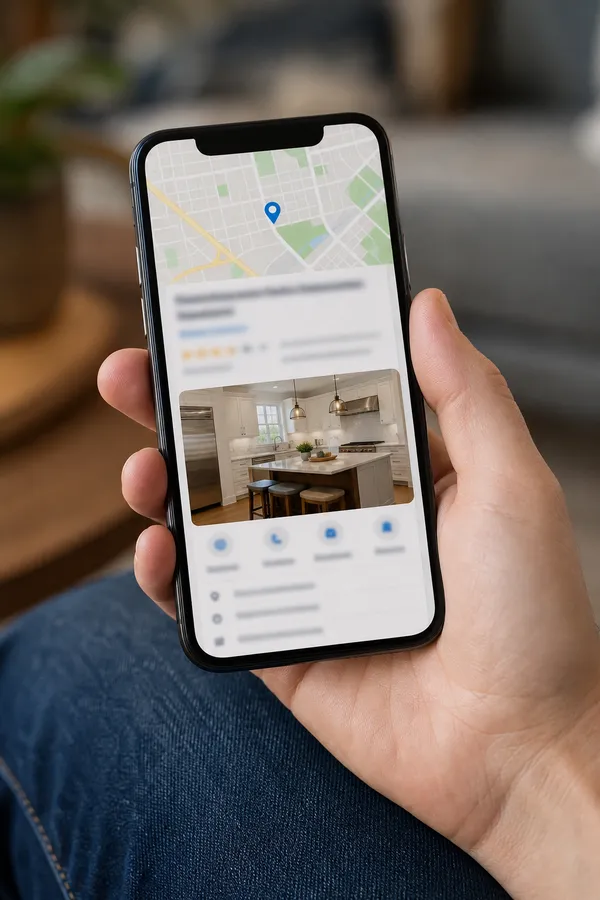
Search “deck builder near me” on your phone. Look at what comes up first. Usually it’s the map, and that map is built from Google Business Profiles. So here’s our short version: pick sharp categories, make the profile match your website, follow the rules Google rewrote in October, and look at it twice a week. Below is the checklist we run for our own clients.
Why the profile counts for more on high-ticket work
When you sell remodels, roofs or new builds, a single job can be worth more than a year of marketing. Every lead we bring in that you close pays for about a year of what we charge. A strong profile is one of the cheapest ways to get those calls. It shows up at the moment someone is ready to hire.
There’s a second reason now. When someone asks ChatGPT or Gemini for a contractor, those tools check your name, address, phone, hours, reviews and mentions on other sites before they recommend anybody (Search Engine Journal).
Setup checklist
Categories. “Contractor” is too broad. If kitchens pay your bills, make “Kitchen remodeler” the primary category, then add each secondary one you actually do. Whitespark looked at 1.8 million profiles and landed in the same spot. Narrow primary category. Every relevant secondary. No blank fields (Search Engine Land).
Service area. If you work at customers’ homes and don’t take visits at your office, hide your address and list the towns or counties you serve. Moving your business? The address and the map pin are separate. Check the pin after any change (Search Engine Land).
Name, phone, hours. Use your real business name with no keywords added. Match the phone number and hours on your website exactly.
Description. Say who you are, what you build or fix, and where you work. Since October 6, 2026, Google’s policy bars prices, time-limited promotions and direct calls to action like “call today for a free estimate” in the listing itself (Search Engine Roundtable). A lot of contractor descriptions break this rule right now.
Services and photos. List each service you want calls for. Add photos of your own crews and finished jobs. Stock photos don’t help anyone choose you.
Posting checklist

- Put offers and seasonal deals in Offer posts with an end date. They’re still allowed there.
- Post finished projects in the towns you serve as Update posts.
- Leave phone numbers, emails and social handles out of post text. Posts with unverified contact info may be removed (Search Engine Roundtable). Use the Call button instead, which uses your verified number.
Review checklist

- Ask every satisfied customer, close to the end of the job, with a direct review link.
- Don’t pay or reward people for reviews unless you disclose it. Google’s guidelines now ban fake and undisclosed incentivized reviews, with manual actions as the penalty (Search Engine Journal).
- Reply to reviews like a person would, good and bad. Users can now report an owner’s reply (Search Engine Roundtable).
- Don’t panic if a batch of spam reviews vanishes. Here’s what happens. Google catches the spike, sends the owner an email, pulls the junk reviews and freezes new ones for a stretch (Search Engine Roundtable).
Keeping it clean after setup
Open your notifications twice a week. A competitor, a random user, anybody can suggest an edit to your profile. You have 4 days to reject it. After that Google may publish it if public sources like your website support it (Search Engine Roundtable).
Fix old info on your website. Google checks suggested edits against your site. Still showing winter hours from three years ago, or the shop you left? Google may decide that’s correct and put it on your profile.
Write down who owns the profile. Record the owner and managers. Keep a snapshot of your settings. If the profile gets suspended, you’ll need that to recover it (Search Engine Land).
The trade-off
The profile gets the tap. Your website has to close the deal. Someone hits “Website” and lands on a service page, and Google and the AI tools read that same page to double-check what your profile says. If the page is thin, the profile can only do so much. We handle both together for that reason. Our post on SEO for contractors covers the website side. For a site we built with speed as the goal, see our Pestcor case study.
Want us to look at yours?
Send us your business name. We’ll pull up your profile, run it against this list and tell you the two or three things we’d change first. Book a 15-minute call or see our SEO services.